
TL;DR: New technologies tend to expand the economic pie, but the transition is painful for those who cannot adapt. For a business, the question is not whether AI is good or bad. It is whether to put it at the center of the value proposition. Doing so brings four risks: supplier over-exposure, barriers to entry, automation backlash and inflated perception. The way forward is to start from the value created for real people, to adopt without Fear of Missing Out, and to build the organizational agility to adapt.
As we navigate the latest advances in AI, the debate on whether technology is good or bad for society is livelier than ever. We see scientists, technology experts, Big-Tech founders and engineers debating the prospects of AI in the short and long term. In the same way, many small and medium business owners and strategists ask themselves how to tell what is hype from what is not. Even more, they ask how to make the most of this new technology wave for their business. Ultimately, one question covers them all: which applications will truly make a difference in people’s lives?
In this post I look at that question from a business angle. First, what existing information technology tells us about who wins and who loses. Then, what should change when a business wants to make AI a central part of its value proposition.
Is information technology innovation a zero-sum game?
AI technology is new, but the debate on whether technology is beneficial is not. When an important new technology appears, there are both enthusiasts and skeptics. The Schumpeterian paradox of creative destruction repeats itself: technology bring long-term economic gains at the expense of short-term social and economic pains.
In fact, despite the promise, in many cases of tehcnology adoption the outcome was a zero-sum game in the short term. Over the years, information technology has brought strong advances in standards of living and new jobs. It made fortunes for those who brought it to market. For others, the same technologies created disruption: job losses, shrinking industries, massive environmental footprints, data privacy infringements, and more.
So, as new information technology is developed and made available to the public, the question of whether it brings benefits, and when, is common to businesses and the public alike. And this is not the first time it happens.
What cloud computing taught us
Cloud computing is an information technology that many companies have adopted in their processes and offerings. It has triggered profound societal changes. It has generated new applications such as e-commerce, ride-hailing, smart cities, fintech and digital health. With them, consumers in developed countries benefit every day from new standards of living. And many businesses captured its value by reinventing themselves and adopting new business models.
However, we can’t deny there has been a flip side to these gains. Cloud computing has accelerated the decline of brick-and-mortar retail jobs and traditional transport industries. At the same time, the rapidly growing reliance on data centers has spurred very high electricity demand and intense local water consumption for cooling.
So the question economists typically ask is: does a new technology really improve overall productivity, and does it do so in an equally distributed way?
On one side, we can say that cloud computing has expanded the economic “pie”. It created a positive-sum outcome of higher productivity and higher standards of living. But the process is painful. It requires the decline, and sometimes the disappearance, of existing industries and of businesses that aren’t capable of adapting to the change. Consumers don’t all benefit equally either. The “digital divide” within and across countries shows that people with internet connectivity and the ability to adapt their lives can reap the benefits. Those who are slower, because of social, cultural or age factors, take more time to adapt.
Hence, a technology can be positive-sum for the economy as a whole and still be zero-sum, or worse, for specific people and businesses in the short term. Who ends up on which side depends largely on how well, and how fast, they adapt. For people, adapting to new information technology has to do with internet accessibility, digital skills, language barriers and monetary costs. For businesses, adoption is usually a matter of return on investment, where the company’s organizational readiness and competitive pressure play a big role.
The future of AI and deep tech: who benefits?
Today’s debate over deep tech such as AI, autonomous robots, quantum computing and genomics is justified. The question for society is not only whether it will bring benefits to humanity. It is also whether the benefits will be equally distributed across society.
A similar caution applies to businesses. Will adopting new technology bring any benefit, or is it more of a bubble? How should technology be adopted to improve competitiveness in the long term without becoming dependent on it? Does it make sense to build the next agent? Does it pay back to be an early adopter of any of these technologies?
What are the risks of building an emerging technology into your business model?
Many times I hear questions from existing businesses like “how can I make my product an AI-based one?”
This is not the typical question about how to integrate a new technology into a business. It goes one step further. It is about making a technology that is still emerging a central part of the value proposition. In a previous post I looked at the opportunity side: five ways AI is transforming products. Whereas, in my last post I looked at general product risks. In this post, I look at the risks of introducing AI as part of a product value proposition from an SME standpoint.
Adopting AI, especially if as a core part of a product, doesn’t just take creating a task force, signing a new supplier agreement, setting up a lab and adapting processes to make space for the technology. It means changing core aspects of the company’s business model, such as value delivery, customer relationships, activities and resources. This is why, it needs careful attention.
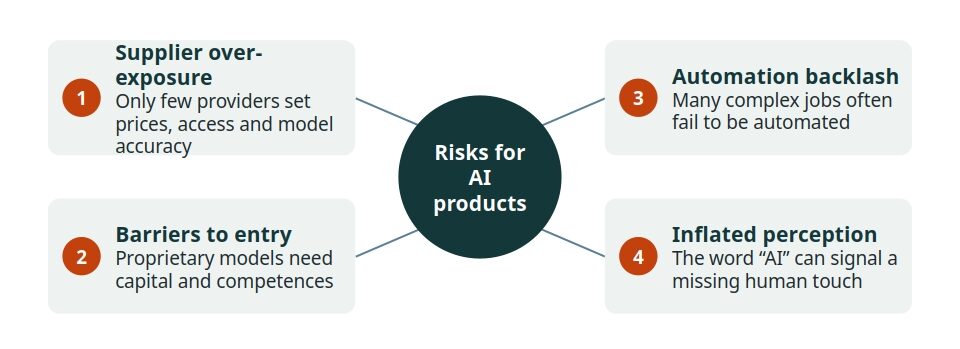
Let’s take AI as an example of a new technology. Making a product’s value proposition AI-driven has four major implications:
- Supplier over-exposure. AI technology is difficult to fully own, because only a few Big-Tech companies own the foundation models. They decide token prices and which model capabilities are available in a given geographical region, and the cost of reaching a certain level of accuracy is mostly unpredictable. Building a value proposition around AI that relies heavily on third-party, closed-source technology is risky.
- Barriers to entry. Building a complete AI model from scratch to be competitive requires capital investment in infrastructure and competences. The cost of building and maintaining models that are at least as effective as fine-tuned foundation models can be high, even in niche applications.
- Automation backlash. Automation performs best for jobs that cover the “3D” use cases: dull, dirty and dangerous. Other cases are riskier. Many companies that adopted AI to automate existing jobs found themselves needing to rehire employees, because automation did not stand up to the level of service and the versatility that humans can provide.
- Inflated perception. AI is surrounded by inflated expectations. Beyond the initial hype and the cool factor, consumers and businesses do not need another AI agent for their business or life. They need a solution to their problem, a support to reach their objective. Telling customers about your use of AI can help. However, the word “AI” can sometimes be a boomerang, because it may suggest the absence of a “human touch”. Backlash against AI in advertising is emerging because AI work is perceived as inferior to human work, and because of the perception it creates of the brand’s values and intentions.
What makes AI adoption work?
Of course, these risks do not apply in the same way to every industry and business. Empirical evidence suggests that introducing AI capabilities to create value for customers is definitely possible. But it requires organizational agility. For a company this means the following:
- Projects and products progress in milestones, where results are presented discussed with customers, before moving to te next step.
- There is constant communication with customers and stakeholders to ensure transparency and alignment.
- Decision-making processes focus on reversible decisions that are taken quickly.
- Open communication channels, both internally and with the customers.
When it comes to adopting new technology, organizational agility can matter even more than available resources. You can invest heavily in AI infrastructure and credits, but if product development and innovation initiatives are sluggish, decisions take ages and communication is poor, those investments may not translate into the expected returns.
By focusing on organizational agility, small and medium companies can narrow the gap with larger competitors, despite having less capital, because they can change their organization faster when needed.
Strategy first, technology second
To wrap it up, investments in an emerging technology should not be abandoned altogether. But they should be considered strategically, without any Fear of Missing Out.
Strategic thinking means looking beyond pure efficiency gains. It is also not about creating the ultimate moonshot. It is about creating new value for actual people. AI and other new technologies offer ways to make the pie bigger that did not exist before. But technology is only a means to an end, not the end itself.
In other words, adopting an emerging technology in the value proposition is costly, so we cannot just try it and see how it goes. Its adoption needs to be aligned with creating new value for customers from the get-go. Then the organization can adapt, prototypes can fail and the technology can evolve. That answers the question we started with: the applications that will make a difference are the ones built around real value for real people, whatever the technology behind them.
If you are weighing where AI fits, or does not fit, in your own value proposition, get in touch.
FAQs
Should an SME make its product AI-based? Not by default. Start from the value you want to create for customers, then check whether AI is the best way to deliver it. Making AI central to the value proposition changes the business model, not only the technology stack, and it brings four risks: supplier over-exposure, barriers to entry, automation backlash and inflated perception.
What is supplier over-exposure in AI? It is the risk of building a value proposition on technology owned by a few providers. They decide token prices, regional availability of model capabilities and the cost of reaching a given accuracy. The more a business relies on third-party, closed-source models, the less control it has over its own product.
Does mentioning AI in marketing help or hurt? It can do either. Telling customers about your use of AI can help, but the word “AI” can also suggest the absence of a human touch, and backlash against AI in advertising is emerging.