When we think about applications of new technologies, we often assume that business profitability and societal benefit are two sides of the same coin. We give for granted that either a business makes a profit or society becomes better off. This trade-off can also be polarizing. Take AI and robotics, for example. Depending on the application we have in mind, we may see these technologies as either very good or very bad for society.
The question to ask, therefore, is whether innovation can be good for both. Can a technology application generate profits and improve society at the same time?
The concept behind Empowering Innovation
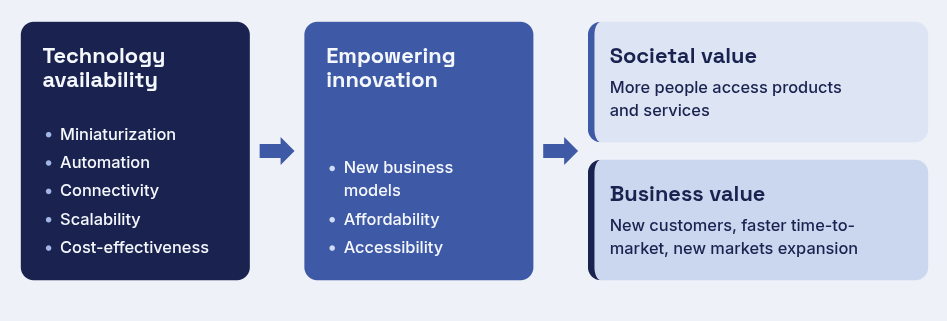
Improving society through technology innovation does not simply mean making an existing customer group better off by giving them technology super-powers. It means making products and services accessible and affordable to people who could not previously access them. Accessibility and affordability relates to what Professor Clayton Christensen called Empowering Innovation: an innovation that transforms complicated and expensive products, previously available to a few, into simpler and more affordable products available to many.
This post explores the characteristics of these win-win technology applications. It discusses how empowering innovations can benefit not only society but also entrepreneurs and investors by generating financial returns.
The first section looks at the bigger picture, using data to show why improvements in well-being do not necessarily translate into greater equality or accessibility. This also points to an opportunity: there is room for innovations that help close the inequality and accessibility gaps.
Next, we examine the characteristics of empowering innovations: the win-win innovations that make society better off without sacrificing profitability. We then look at selected examples and explore what makes these innovations attractive from a business perspective. Finally, we address a central question: if empowering innovations are so beneficial, why are there not more of them?
When technological progress improves societal outcome
Technological progress does not necessarily translate into equal outcomes for society. The benefits for one group do not always extend to others, especially when it comes to income distribution.
We are clearly experiencing a period of rapid technological innovation. And several indicators of global well-being have improved. According to the World Bank, global life expectancy has reached 73.5 years, its highest level ever recorded. And global GDP per capita grew by 2.0% in 2025.
At the same time, income remains highly unequal. According to the World Inequality Report 2026, the top 1% of the population receives 20% of global income. Between 1980 and 2025, average income per adult grew by approximately 1.1% per year across the global population. The bottom earning 50% of the population experienced average annual income growth of 1.8%, although from a much lower income base than the rest of the population. Still, the income of the top earning 0.1% of the population grew by more than 2% per year.
A 2024 empirical study published in Humanities and Social Sciences Communications explores the relationship between technological innovation and income inequality. Based on data from 59 countries between 1995 and 2020, the study finds that technological innovation can exacerbate income inequality, particularly in developed economies.
Targeting the equality gap
The reasons for such an unequal outcome are multiple. New technologies change the skills that employers need from workers. As a result, workers who are already skilled can adapt quickly and see their pay and opportunities rise. On the other hand, workers with fewer skills often fall behind. Technology innovation can also favor certain types of specialized expertise over routine labor. As a result, a greater share of the economic benefits go to people with specialized expertise.
These implications do not mean that technological progress necessarily makes society more unequal. They rather highlight that technological innovation often requires two complementary actions to ensure that the benefits of technological advancements are more widely shared. These actions are also opportunities for policymakers and businesses:
- For policymakers: Introduce appropriate regulations and education policies that equip citizens with the skills needed for the digital age and support low-income groups.
- For businesses: Address gaps in access to technology applications by developing affordable offerings for people who are currently underserved or unable to access them. This represents an opportunity to meet previously unmet needs while opening up new markets.
In the remainder of this post, let’s address the opportunity for businesses.
Empowering Innovation: addressing unmet needs to create new markets
One question business leaders may ask is how to use innovation to create products and services that not only generate enough profit to justify the risks of innovation, but also help reduce inequality. At first glance, research and evidence on the relationship between technological innovation and income inequality may suggest that these objectives are contradictory. Nevertheless, there are examples where innovation can make society more inclusive by expanding access to products and services.
This kind of innovation is not the usual one, though. It has some specific features that make it different. This is what Clayton Christensen calls empowering innovation. Today, the Christensen Institute refers to this type of innovation as market-creating innovation.
The definition is the following:
“Empowering innovations transform complicated, costly products that previously had been available only to a few people, into simpler, cheaper products available to many.“
[Source: Clayton Christensen, We are living the capitalist’s dilemma, CNN, 2013]
Applying empowering innovation
The philosophy is not simply about using enabling technology to reduce production costs so that prices can go down, sales volumes can increase and profits can grow. It is about using enabling technology with new business models to create new value for people who could not previously access a product or service. In a way, it is about transforming complicated and expensive offerings into simpler and more affordable solutions for new customers.
Consider autonomous vehicles. Could they make society better off? Potentially. They may improve road safety and make point-to-point transport more convenient. But do they solve the accessibility problem? Not necessarily. A privately owned autonomous car may still be unaffordable for many people who could benefit from it. To improve accessibility, the technology would need a different business model such as a cost-effective on-demand service. For example, people who could not afford to buy an autonomus vehicle or pay for a taxi ride, can use an on-demand robo-taxi service that aggregates demand and provides with an accessible ride fee. Automation technology is critical to this kind of innovation. But the real value comes from wrapping it into a service accessible to people who cannot otherwise benefit from it. A business model that empowers people through accessibility and affordability creates a win-win.
The highest potential for empowering innovations is in areas such as credit, health care, education and energy. This is where many people still struggle to access essential products and services.
Once we recognize the value of an empowering innovation, the next question is what it means for established companies with products and services already on the market.
For established companies, creating an empowering innovation may require diversifying their product portfolio to serve new customers. It may also require developing new business models, pricing structures and distribution channels to make their products accessible and affordable to people who were previously unable to access them. For other companies, the opportunity may be even closer. Existing customers may already have unmet needs that current products and services do not address. They may already purchase certain products or services but still lack access to complementary or adjacent offerings because these are too expensive, complicated or inaccessible.
Three different cases of empowering innovations
History is full of examples of empowering innovations. Some are more obvious than others. Let’s look at three cases that illustrate different scenarios.
The first is a traditional example from a developing market, where an innovative business model makes an essential product accessible to low-income households. The second focuses on healthcare, where technological innovation makes diagnosis more accessible and affordable in both developed and developing countries. The third shows how an established company can make transportation more widely accessible.
1. Decoupling investment from payments to make electricity accessible: M-KOPA Solar
One of the most powerful real-world examples of empowering innovation targeting non-consumers with an unmet need is M-KOPA Solar in East Africa.
Before M-KOPA, many low-income households in countries such as Kenya, Tanzania and Uganda lacked access to reliable grid electricity. They had a clear need for safe and reliable power and lighting, but conventional solar home systems required a large upfront investment that many households could not afford. Instead, many relied on kerosene lamps, which were expensive, polluting and potentially dangerous.
M-KOPA introduced a small, affordable solar home system containing a solar panel, LED lights and a phone charger, with some product versions also including a radio. Rather than requiring customers to pay hundreds of dollars upfront, M-KOPA embedded GSM technology into its solar systems and introduced a Pay-As-You-Go (PAYG) model.
Customers made a small initial deposit (historically around $30) and then paid small daily installments (approximately $0.40) through their mobile phones using mobile money services such as m-pesa, another empowering innovation. These payments were comparable to what many households were already spending on kerosene and other energy alternatives. If a customer stopped making payments, the system could be remotely deactivated until the account was topped up. Once the system was fully paid off, customers owned it outright and could enjoy electricity without further installment payments.
The innovation was not simply the solar technology itself. It was the combination of solar technology, mobile payments and an innovative financing model that made electricity accessible to households that could not previously afford conventional solutions.
2. Addressing an unmet need in healthcare: Portable ultrasound diagnostics
Another powerful example of empowering innovation is the shift from bulky, expensive cart-based ultrasound machines to handheld, point-of-care devices.
Instead of using semiconductor technology simply to improve image quality or processing speed, Butterfly Network leveraged semiconductor technology to develop a pocket-sized ultrasound device.
Traditional ultrasound equipment can cost tens of thousands of dollars and is typically located in hospitals and specialized imaging centers. Butterfly Network developed an ultrasound-on-chip technology that made it possible to integrate ultrasound transducers into a semiconductor-based device. This significantly reduced its size and cost.
The result was a handheld ultrasound device that could be connected to a smartphone or tablet and used by trained healthcare professionals at the point of care.
This created new opportunities to make ultrasound diagnostics more accessible, extending their use beyond specialized imaging departments to clinicians working in emergency departments, primary care, home-care and resource-constrained healthcare settings.
The innovation was not simply about making an existing ultrasound machine smaller. It was about making a specialized diagnostic capability more accessible to a broader group of healthcare professionals and patients.
3. Making car ownership accessible: Dacia Logan
Empowering innovation is not limited to technology-intensive industries or digital business models. It can also come from rethinking how traditional products are designed and manufactured. A good European example is Dacia Logan, developed by Renault Group and launched in Romania in 2004.
At the time, buying a new car was beyond the reach of many households in Central and Eastern Europe. Their alternatives were often older second-hand vehicles or no car at all. Renault identified an opportunity to serve this untapped market by developing a modern, reliable family car at an ambitious target price of approximately €5000.
Rather than designing a conventional car and subsequently trying to reduce its price, Renault started with the target price and designed the vehicle around it. The company focused on essential features such as reliability, durability and interior space. They used product simplification as guiding product development strategy.
Initially designed for emerging markets, it was subsequently introduced across Europe, where it also attracted customers looking for an affordable new car.
The innovation was not about introducing breakthrough technology. It was about rethinking product design, development and production to make a previously expensive product accessible to a much broader group of customers.
For Renault, this also created a new market opportunity. Instead of competing exclusively for customers willing to pay for increasingly sophisticated vehicles, the company could reach people who had previously been unable or unwilling to purchase a new car.
Economic returns of empowering innovation
Targeting low-income populations as a market is one way for a company to help reduce inequality among consumers. By doing so, society can become better off. The question that comes next is how much this vision penalises or rewards a company whose ultimate goal is to create value for all its stakeholders. Society is only one of them.
To put it simply, wouldn’t it be more profitable and sustainable for a company to address the needs of the wealthiest parts of the population, which typically have a higher willingness to pay and can therefore support higher profit margins? Just for the sake of example, wouldn’t it be more profitable to bring a Tesla Roadster rather than a Dacia Logan to market? On one side, there are affluent early adopters and performance sports car buyers in North America and Europe willing to pay a premium for an electric vehicle. On the other, there are cost-conscious, first-time new-car buyers in Central and Eastern Europe. Choosing the initial target market is an important dilemma, especially for startups that own a technology and need to find the first market positioning for their technology.
However, empowering innovation is not about social responsibility or addressing the bottom of the pyramid for its own sake. It is, first and foremost, a way to open new markets. In other words, empowering innovation targets affordability and accessibility, and the income level is often a side effect.
Why affordability and accessibility make the difference
Thinking in terms of affordability and accessibility is essential. The greater the customer pain, the greater the potential demand for a solution. But a higher pain does not necessarily translate into a higher willingness or ability to pay. If available products are too costly compared with what customers can afford, they become inaccessible. Conversely, a product can be affordable but too complex or difficult to use. So, as long as there is a market segment with a clear and consistent need and a gap in affordability, accessibility, or both, there is an opportunity to innovate by bringing technology to that market.
Tesla Roadster customers had alternatives. They could choose other high-performance sports cars, such as the Lotus Elise, to get their adrenaline rush. But they were willing to pay a premium because Tesla combined high performance with electric mobility and environmental appeal.
Dacia Logan customers, on the other hand, did not have a choice. They were looking for an affordable and reliable new vehicle. The Logan addressed a need that many cost-conscious consumers could not satisfy through the new-car market at the time.
Both the Tesla Roadster and the Dacia Logan opened up market opportunities and were commercially successful, but for different reasons. Dacia Logan addressed an accessibility gap through affordability. Tesla Roadster did not. It targeted an affluent niche willing to pay a premium for a new type of product. This is why Dacia Logan can be considered an empowering innovation, while Tesla Roadster is a different kind of innovation.
So, back to the original question: what are the potential returns of filling the accessibility and affordability gaps?
1. Lower initial competition
Selling a new product to new customers is generally riskier than upgrading a product to serve existing customers. Understandably, it sounds easier to use new technology to serve existing customers with a better high-end product, than to develop a low-end product to satisfy an unaddressed need.
However, this inevitably comes with competitive risk. Every time a new technology becomes available, unless it is unique to the company that develops it, it may also become available to competitors. Therefore, competitors can make the same move and upgrade their products. From that moment on, it can easily become a race to the bottom.
On the other hand, giving new possibilities to customers to perform a job they could not previously afford to perform, or addressing a need they could not previously satisfy in an affordable way, can create a whole new market with limited direct competition, at least initially. In this case, the company is not necessarily competing against existing products, but against “non-consumption” and the workarounds customers currently rely on.
2. Lower performance requirements level
Focusing on specific, previously unaddressed needs, causes another advantage for companies. There are fewer requirements to satisfy because customers do not have similar products to compare. In other words, technical performance is not a competitive advantage because there is no benchmark to compare to. By removing technical performance as a critical product success factor, the risk of product failure shrinks, provided the product still delivers the value customers need.
The same goes for usability. To be accessible, the product must be usable. However, early adopters may be willing to accept a less polished product experience as long as it performs the functional jobs they need it to do. In general, when entering a new market, some product risks such as usability and the need for extensive market evidence may differ from those in established markets. Customers who are innovators and early adopters may care less about a polished user experience and more about the value they receive. They may also require less evidence before adopting a product and have a greater willingness to make a leap of faith.
3. Easier testing for product-market fit
Many empowering innovations do not bring any new technology to the table. Often, they simply reposition existing technology to serve unaddressed needs. This can make product-market fit easier and less expensive to test.
On the cost side, a Minimum Viable Product (MVP) may be easier to build because it can reuse existing technology. On the value side, the market need may be simpler to test because customers do not have alternative products to choose from. Whereas, customers in markets already served may not clearly see the unique selling point of a new offering compared with existing alternatives.
Be careful, though, that the absence of direct competitors also increases uncertainty around market adoption, as no other companies may have served that market before. Hence, empowering innovations need laser-focused clarity on the target market and the value proposition.
4. Superior returns
Being among the first companies to create a new market can be an advantage because it allows a company to establish its position, build customer relationships and develop specific capabilities before competitors enter.
INSEAD professors Kim and Mauborgne, who wrote the groundbreaking book Blue Ocean Strategy, studied 108 business launches across multiple industries. They found that only 14% of these launches were aimed at creating new market spaces. Despite representing a minority of launches, they generated 61% of the total profits across all launches.
5. Volumes expansion
Lack of accessibility and affordability is often widespread. This means that identifying an underserved market and targeting it with a viable offering can unlock large sales volumes. However, profitability also requires keeping costs under control to achieve sufficient margins. Three aspects are therefore critical:
- eliminating features that customers do not value
- simplifying production
- reducing distribution costs.
Back to Dacia Logan, Renault did not disclose the individual profit margin of the model. But a 2013 Morgan Stanley estimate put Dacia’s worldwide operating margin well above Renault’s. This contributed to Dacia becoming a cash-cow for Renault.
Where companies fail with empowering innovations
If empowering innovations are so attractive, why don’t we see more of them around us? Sustaining innovations that upgrade existing products to better serve existing markets are much more common.
The problem is not technology. It is rather strategy.
When companies adopt AI and other technologies, they need to see a clear path to returns. The bigger the company, the greater this need. In general, it is safer to justify the launch of a product that is a clear step-up on a previous product, rather than a product that solves a problem no other product solves for people that have given up looking for a solution.
There are three main reasons why companies do not develop more empowering innovations.
- Using the wrong success metrics
- (Not) targeting an understated need
- Overlooking the business model
1. Using the wrong success metrics
Many large companies struggle to serve underserved markets because they often offer lower initial gross profits, smaller market opportunities and less predictable returns. As a result, established companies may prefer to target high-margin premium customers, even when this means competing head-to-head with other companies.
This causes what Clayton Christensen called the Innovator’s Dilemma. When a product manager runs an NPV analysis on a low-margin, unproven market, the numbers may look unattractive. The high discount rate used to account for market uncertainty can make the project appear financially not viable. The financial model may therefore favor an innovation that cuts costs in an already profitable market or offers an improved feature at a premium to existing customers.
According to Christensen, this is partly due to the wrong success metrics. Indeed, to create more empowering innovations, companies and investors need to look beyond short-term profitability. They should rather focus on long-term market-generation metrics, such as the number of previously underserved customers reached and rate of adoption. They should also treat uncertainty as something to explore and manage, rather than simply as a risk to avoid. A more flexible approach to innovation investment decisions can help companies avoid foregoing promising innovation opportunities while managing the financial exposure.
2. (Not) targeting an understated need
Another reason why empowering innovations are overlooked is that “non-customers” may not be able to articulate a need for a solution they have never seen. They may not know what solution is possible until they see it. The familiar quote, often attributed to Henry Ford, captures this idea: “If I had asked people what they wanted, they would have said faster horses.” This means that customer discovery might take a while and requires more than simply asking people what products they want. It also requires understanding their problems, workarounds and unmet needs.
3. Overlooking the business model
The final aspect of why there are not so many empowering innovations is the importance of the business model. An empowering innovation requires many pieces of a puzzle to work together. It is not enough to have a great value proposition if you cannot solve the whole business model puzzle. Pricing, distribution, product architecture, partnerships and cost structure need to align to make the value proposition accessible and affordable for a specific customer segment, while ensuring that the business remains profitable.
To create empowering innovations, M-KOPA, Butterfly Network and Dacia Logan did not necessarily innovate at the technology or application level. They mainly innovated at the business model level, rethinking how their products and services are priced, financed, produced, distributed and delivered.
The opportunity ahead
Clayton Christensen’s concept of empowering innovation reminds us that innovation is also about rethinking complicated and expensive products to make them accessible and affordable to people who could not previously benefit from them.
Today, we have more technological capabilities than ever. AI, robotics, quantum computing and other technological advancements are opening up possibilities that were unimaginable just a few years ago. Yet, significant gaps in accessibility and affordability remain. This creates an opportunity for businesses to rethink how technology can generate value for both society and shareholders.
A few key takeaways:
- Technology is an enabler, but not enough. What matters is how we apply technology to solve previously unmet needs and make products and services accessible to more people.
- Accessibility creates markets. People who cannot afford or access existing solutions are not necessarily a market without demand. They may represent an opportunity.
- Empowering innovation can be profitable. By addressing affordability and accessibility gaps, companies can unlock new customers, expand consumption and build sustainable sources of growth.
- Business models make the difference. Making technology affordable and accessible often requires rethinking pricing, distribution, partnerships, cost structures and the overall value proposition.
- Uncertainty can be an opportunity. Short-term profitability and existing financial metrics may obfuscate opportunities with significant long-term market potential.
Some of the biggest product opportunities may lie where people have difficulty to access and afford technology.
Post photo by Camille Chambefort on Unsplash.