Any product leader has been there a few times. It is the beginning of a new product development effort, be it a new product or a feature. Requirements are clear, or at least that is how they appear. The product team is ready and excited. Then comes the question, usually from a sponsor or a customer: “How long will it take to go to market?” In this post, we will explore how to truly answer this question by using a simple blueprint with 9 blocks, so that next time you will not walk away with that nagging feeling of having given the wrong answer.

Why it matters
Let’s go back for a moment to the fatidic estimation question: “how long will it take to market?”
When I am asked this, here is what usually happens in my mind. One half has already an expected date, especially if I have already spoken with the development team, and is eager to answer right away. The other half wonders: “what if something goes wrong?” In the end, a compromise wins. I often take the expected date, approximate it in weeks or months depending on the project size, and multiply it by a factor between 1.5 and 3 depending on uncertainty.
Of course, people approach this question differently. Some ask for time to consult the team or domain experts and return with a more “considered” estimate. Others use a 3-points estimation, where they average the best-case, the worst-case and the most-likely estimates to generate a final estimate.
These different estimation approaches work well as quick heuristics (to dive deeper into heuristics in decision-making, read the previous post), but they are not always the most appropriate, especially when the answer must be accurate.
Despite all the caution we may take in the moment, answering this kind of quantitative question requires real effort — and it can come with a cost later, when everything becomes more concrete. The newer the product, the more uncertain the requirements, and the more innovative the project, the more important it is to answer this question properly for the sake of credibility.
The good news is that in these high-uncertainty situations, there are better ways to approach the “when” question. And it’s not only about giving a more accurate answer. It’s about reframing the problem entirely. In fact, we will see a blueprint to estimate product time-to-market.
Framing the question
We often take this question as is, but there is usually more behind what we ear. Whoever asks might be interested in more than just timing. They might be pointing at budget or time constraints, or that further support is needed. In other cases, it might simply be a routine check-in.
Understanding the reason why the question is being asked is important to address the real concern. In fact, the most effective answer is not a straight number, but a clear explanation of what the project requires to be successful. Still, it helps to be prepared when the question comes up. And if it arrives unexpectedly, there’s often nothing wrong with asking for time to gather the right information.
To answer the question properly, we first need to clarify the three core project constraints. They are the foundation of the 9-parts blueprint that allows us to respond thoroughly by setting realistic expectations that consider risk throughout product development. In classical project management, these constraints are:
- Scope, which defines what the project must deliver to be considered successful.
- Budget, which covers all the financial resources required to complete the project.
- Time, which includes the deadlines and schedule needed to deliver the scope.
The blueprint for a reliable answer
Scope, budget and time help shaping a more accurate “time to market” estimate. However, since we are in product development, we can interpret them as more specific, with their own nuance. So, let’s consider them as product scope, project resources, time-to-value. These are in essence the 3 main blocks of the blueprint. Each has 3 different parts. Together, they look like in the following table:
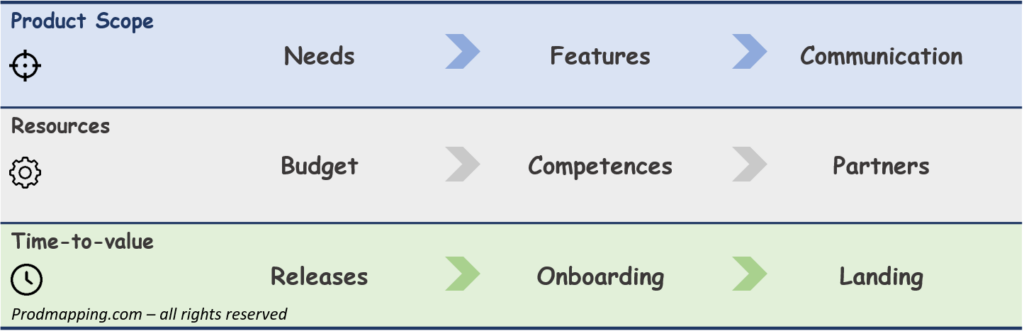
Let us explore each part one by one.
1. Product Scope
Product scope is essential and it is easy to create misalignment with stakeholders’ expectations. So, what does scope entail in product development? Here are its 3 cornerstones: needs, features, communication.
Needs
Often overlooked, needs are the very reason a product or service exists. They also provide a baseline for validating the product, which is why any scope definition must start with a proper needs analysis. And “needs” don’t only refer to customer needs. They include internal stakeholder priorities and compliance requirements such as laws, regulations, and guidelines, especially in regulated industries.
It’s important to give stakeholders space to explain and justify their needs. Not all needs are explicitly stated. Some are unspoken and reflect underlying problems or frustrations. Many smaller needs only surface once users see or interact with the product. For this reason, we must stay open to new needs as they emerge. At the same time, we need to protect the project from scope creep, the uncontrolled expansion of scope due to newly introduced needs. A practical way to manage this is to agree early on which needs are essential for the initial delivery while allowing a limited margin for additional needs during development.
Features
Features derive from needs. They comprise what the product will do and show. In terms of scoping, the more we can define the features beforehand, the better it is. Are all the product features clear from the outset, or will the product be delivered with a minimum set of features to test whether it meets the needs of the market? Story mapping is an excellent technique to explore real-world scenarios before the product comes to life. Needs also provide with the basis to prioritize which features are “must have“, rather than “should have” or just “nice to have”, according to the MoSCoW technique.
Communication
For any new product, consumer or business, timely communication is crucial to ensure enough people show up at launch. Even for established products, announcing new features to clients and prospects is a good practice that let clients feel valued. Communication can mean testing the market earlier with messaging that simulates the final offering, helping evaluate interest, pricing, and expectations. While this may feel like early scoping, it can also serve as a final validation before release. In every case, communication is about telling people the product is coming and giving them a reason to get excited. This requires close collaboration with marketing and sales, who lead the effort but rely on constant updates to communicate accurately and effectively. Managing this work as part of the overall timeline is essential, so communication activities support, rather than disrupt, the critical path of product development.
2. Project Resources
Budget is, for good reasons, the most cited project management constraint. Without it, most projects could not even start. Yet, when talking about product development, thinking more broadly about resources in general can help have a clearer picture of what it will take to reach launch. So, the 3 types of resources to estimate time-to-market are budget, competences and partners.
Budget
Again, budget is vital for almost any product. Knowing how and when funds will be available helps manage risk and improve delivery forecasts. A startup, for instance, may depend on investor funding, while another company might rely on crowdfunding, where the budget depends on how many customers pay in advance.
Competences
Innovative products take more than just good ideas and doing things right. They take strong and focused product teams. The right people can make the difference, turning plans into real impact through creativity and efficiency. Teams that believe in what they are doing push further, especially when the path is not clear. And that’s not just true for R&D-heavy products, but it applies to almost any new venture. With all the technology at our fingertips today, thinking differently can be the real differentiator. As product managers, we should always ask ourselves: how strong is our team, and where will their effort create the most value? The answer often shapes how fast we move, how much return we create, and what new opportunities we uncover.
Partners
Partners are more than suppliers or distributors paid for a service. They are organizations that co-invest to create new capabilities, open new markets, or improve how we work. They bring something new to the table and share in the long-term rewards.
For example, a vendor might build new APIs to integrate with our product, or a distributor might adjust its channels to reach new customers. These partners think strategically. They see beyond short-term deals to lasting opportunities.
The product manager’s job is to guide these partnerships so their efforts deliver the right value at the right time.
3. Time-to-value
Once we have all our considerations regarding product scope and resources, we are ready to estimate time-to-market. We need first to define what it takes to get to “market”. And it does not just end with launching the product and making it available to public. In fact, there are three aspects to consider prior and after launch.
Releases
Defining releases beforehand is important to have clear when the actual product value will be delivered. Will the product be released in stages to test it with different user groups? For example, there might be alpha and beta releases to gradually gather feedback from real users. In other cases, the product could be made available to different segments to see which group shows the most interest. Before the actual launch will there be some kind of MVP (minimum viable product) to validate product–market fit early on? These are some of the questions that is relevant to consider as part of a release plan, that inevitably impacts the timeline.
Onboarding
We often assume that once a product is live, customers will use it effectively. In reality, most products require time for users to adapt. During this transition period, it’s crucial to keep customers motivated and engaged so they don’t lose interest or drop off. That is where onboarding comes in. It’s the journey that helps users get up to speed and feel confident with the product. Depending on the offering, onboarding may involve dedicated training or simply well-placed cues in the UX that guide users through the trickiest steps. Factoring in the time needed for customers to ramp up is essential to maximizing the return on product development and ensuring the product truly meets their needs. Without a complete onboarding experience, the product’s value remains only partially realized.
Landing
We often think that product development ends at launch. In reality, it is just the beginning. What truly matters next is the product “landing”, the first period of real use right after launch. This stage is crucial for gathering user feedback and confirming that the product meets its promised needs. Although every product has a first market debut, it usually re-enters the market many times through new features, improvements, and fixes. In fact, we cannot truly understand a market until we see how it behaves with our product in it and use those insights to refine the product–market fit. Having the product in customers’ hands is a far greater advantage than waiting to launch until every advanced feature is ready.
What about quality?
If you are familiar with project management, you may wonder why we have not discussed quality alongside scope, budget, and time. In traditional project management, quality links to those three constraints. In product management, however, quality is not something to compromise. Many consider MVPs as “lower-quality” versions of the final product. That is not accurate. An MVP simply delivers fewer features, while still aiming to provide high performance and a solid user experience from day one.
Of course, some products have a direct relationship between quality, time, and effort. An R&D-driven product that relies on machine learning, for example, gains value as model accuracy improves. But the challenge is that achievable performance, with the marginal gains from additional effort, are usually unknown early on. Making fixed assumptions about them can be risky.
What matters is acknowledging this uncertainty and factoring it into release planning. Quality should not be traded off. Instead, understanding, monitoring, and building quality into the scope is essential.
Back to the question
After this discussion, let’s return to the original question: “How long will it take to go to market?”
As we have seen, there is no straightforward answer unless all the components are laid out and properly considered. To do so, we went through a 9-part blueprint to see that the answer cannot come from simply throwing out a number. It requires qualitative context to make the estimate meaningful. Providing this explanation can spark conversations about overlooked aspects, clarify expectations, and ensure alignment across stakeholders.
Ultimately, taking the time to answer thoughtfully does not just provide a number, but it builds credibility, informs better decisions, and increases the chances of product success.